
Cannabis Potassium Deficiency: Symptoms, Causes & How to Fix It
Potassium (K) is the plant's regulator. It controls the opening and closing of stomata, moves water and sugars through the plant, activates dozens of enzymes and helps plants handle heat, drought and disease. In flower, potassium supports the transport of sugars to the buds, which is why it plays a direct role in bud density and final weight. Demand peaks from mid-flower through bulking — exactly when a shortage costs the most
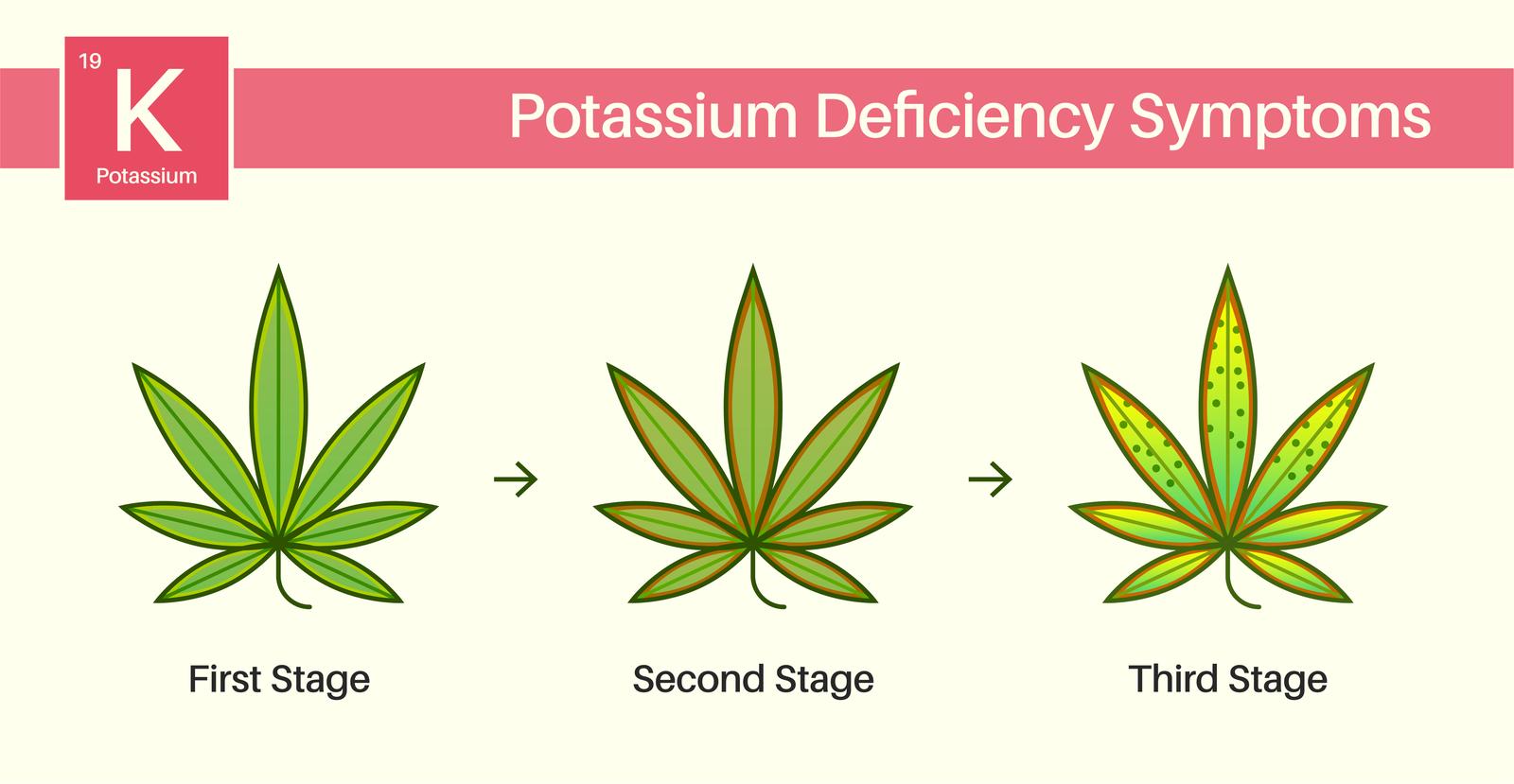
How to recognize potassium deficiency
Potassium is mobile, so the plant moves it from older leaves to new growth. Symptoms start on older and middle leaves.
- Yellowing that starts at the leaf tips and edges, then turns brown and crispy, as if the edges were burnt.
- Rust-colored or brown spots along the leaf margins.
- Leaf edges curling upward, while the center of the leaf may stay green.
- Long, weak, stretchy stems that struggle to support heavy colas.
- Smaller, less dense buds and lower yield when it hits in flower.
Tip: brown tips alone usually point to nutrient burn (too much feed), not potassium deficiency. Potassium deficiency shows yellowing and browning along the whole margin, moving inward, on older leaves.
Common causes
How to fix potassium deficiency in cannabis
- Check pH and EC at input and runoff (or in the reservoir for hydro).
- If EC in the runoff is much higher than the input, flush with pH-adjusted water to clear salt buildup.
- Feed a bloom formula with adequate potassium during flower or add a soluble potassium source such as potassium sulfate at label rates.
- Check source water for sodium and excess calcium or magnesium and adjust the recipe accordingly.
- Monitor new growth: damaged leaf edges won't recover, but the problem should stop spreading within about a week.
Don't overcorrect
Excess potassium blocks the uptake of calcium and magnesium and can trigger a Cal-Mag deficiency. Heavy PK boosters are a frequent cause. Balance and accuracy beat "more."
Deficiency at a glance
| Potassium deficiency |
Mobility | Mobile — older and middle leaves first |
Key signs | Yellow-to-brown burnt leaf edges, rusty margin spots, upward curl |
Peak demand | Mid-flower to bulking |
Ideal pH | Soil 6.0–7.0, hydro/coco 5.5–6.5 |
Common mix-up | Nutrient burn, light/heat stress, magnesium deficiency |
How Dosatron helps
Potassium management is a balancing act: too little reduces yield, too much locks out calcium and magnesium. Dosatron water-powered proportional pumps inject concentrated nutrients at a constant ratio, whatever the flow or pressure, so every plant gets the same feed. Installing units in series lets you dose base nutrients and bloom boosters separately and fine-tune potassium during flower — with no electricity required.
Older and middle leaves, because potassium is mobile in the plant.
Reach out to us