
Operational Context
The Dosatron range is specified for emergency and off-grid drinking water by five distinct categories of operator. Each carries its own constraints and its own dosing requirements.
Operator | Typical context | Typical configuration |
Disaster relief organizations | Post-flood, post-hurricane and post-earthquake potable water restoration; refugee camp water points; medical post supply | D14WL or D40WL with collapsible stock tank and retention bladder |
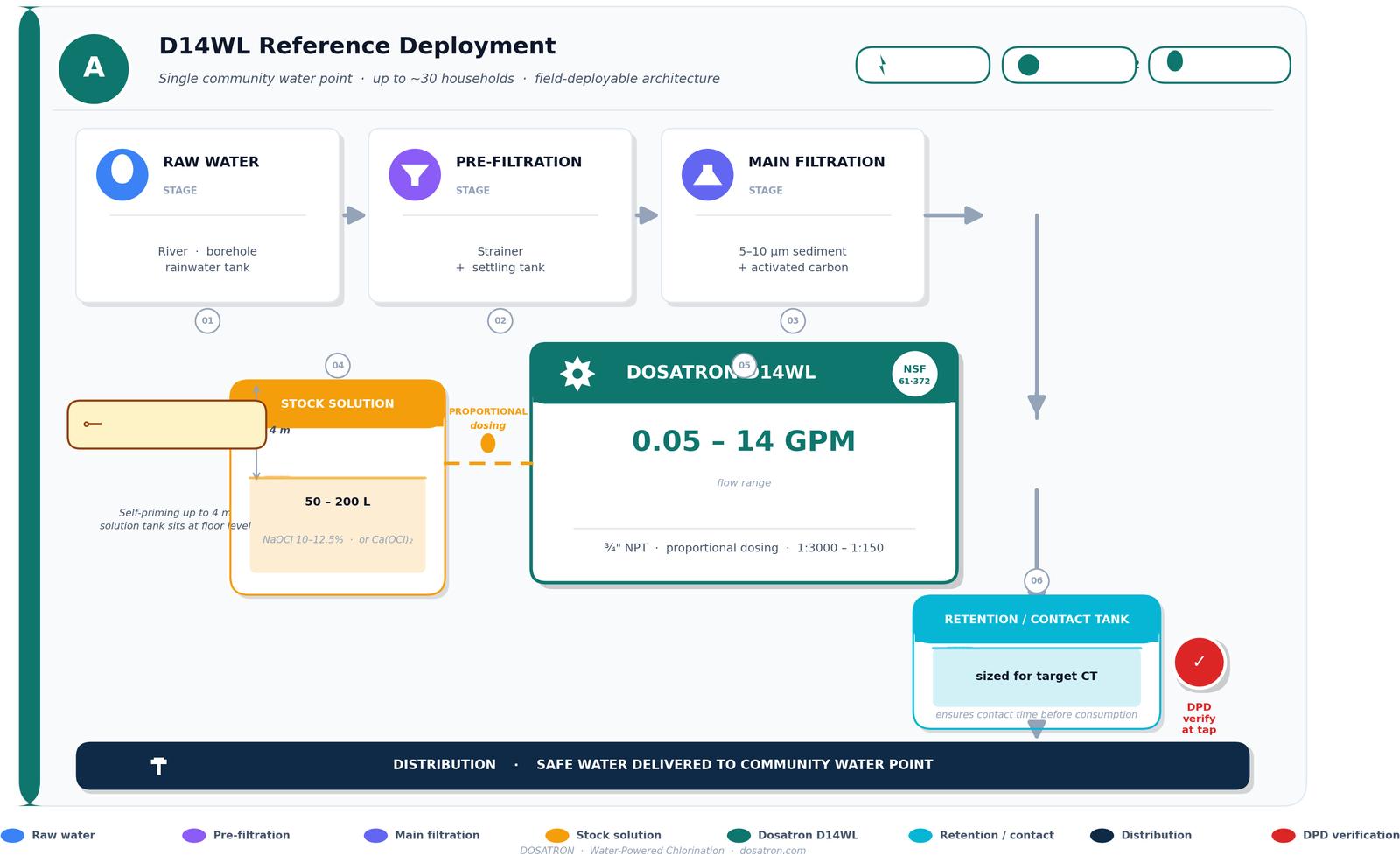
NGOs deploying community water systems | Low-infrastructure regions, gravity-fed surface or borehole sources, school and clinic supply, long-duration field programs | D14WL skid with pre-filtration and activated carbon polish |
Military field water units and engineering corps | Forward operating bases, training exercises, expeditionary deployments | D40WL on tactical bladder tanks, ruggedized enclosure |
Mining, oil & gas and construction camps | Worker potable water for off-grid sites with no municipal supply | D40WL on the borehole-to-camp service line, NSF 61 mandatory under most occupational health frameworks |
Municipal emergency response teams | Post-main-break, post-treatment-plant-upset and seasonal advisory response; mobile potable water distribution | D14WL or D40WL on a trailerized deployment kit |
All five categories share a common requirement: continuous, verifiable free chlorine residual in environments where instrumentation, operators and infrastructure are limited or intermittent. The Dosatron range is engineered for that requirement.