
Mixing Coolant, There’s a better way with Dosatron
In metalworking, precision is the whole point — including how you mix your coolant. Most shops still rely on one of two methods: hand-mixing concentrate into water with a bucket and a paint paddle, or a venturi-style eductor bolted to the top of a drum. Both feel adequate right up until the moment they aren't — a rancid sump, a rusted fixture, or a tool that wore out three shifts early because the mix was never quite right.
The problem isn't effort. It's physics. Hand-mixing depends on an operator's measurement under time pressure. Venturi mixers depend on a pressure differential that shifts every time another machine draws water. Neither method holds a fixed ratio — and coolant concentration is not a detail you can afford to get approximately right.
Why a Venturi Mixer Isn't the Precision Tool It Looks Like
A venturi (eductor) mixer works on the Bernoulli principle: water forced through a constricted nozzle creates a localized low-pressure zone that draws concentrate up from the drum through a suction tube. It's simple, passive, and inexpensive — which is exactly why it's so widely used. But the ratio it delivers is a function of the pressure differential across the nozzle, and that differential is never constant on a real shop floor.
- Ratio drifts with pressure. Most venturi mixers need a minimum inlet pressure to function correctly; when shop pressure drops — during peak draw, first thing in the morning, or when several machines fill at once — the concentration shifts with no indication to the operator.
- Drum level affects performance. As the drum empties, suction head increases and the ratio can drift further, meaning the last portion of a drum may mix at a different ratio than the first.
- Viscosity matters. Venturi mixers are typically rated for coolants below a defined viscosity threshold; heavier semi-synthetic and full-synthetic concentrates may not draw reliably, quietly under-concentrating the mix.
- "Set and forget" is the risk, not the benefit. The ratio is usually set once at commissioning and rarely re-checked — concentration drift goes unnoticed until a refractometer catches it, if it's ever checked at all.
How Dosatron Mixes Differently: Positive Displacement, Not Suction
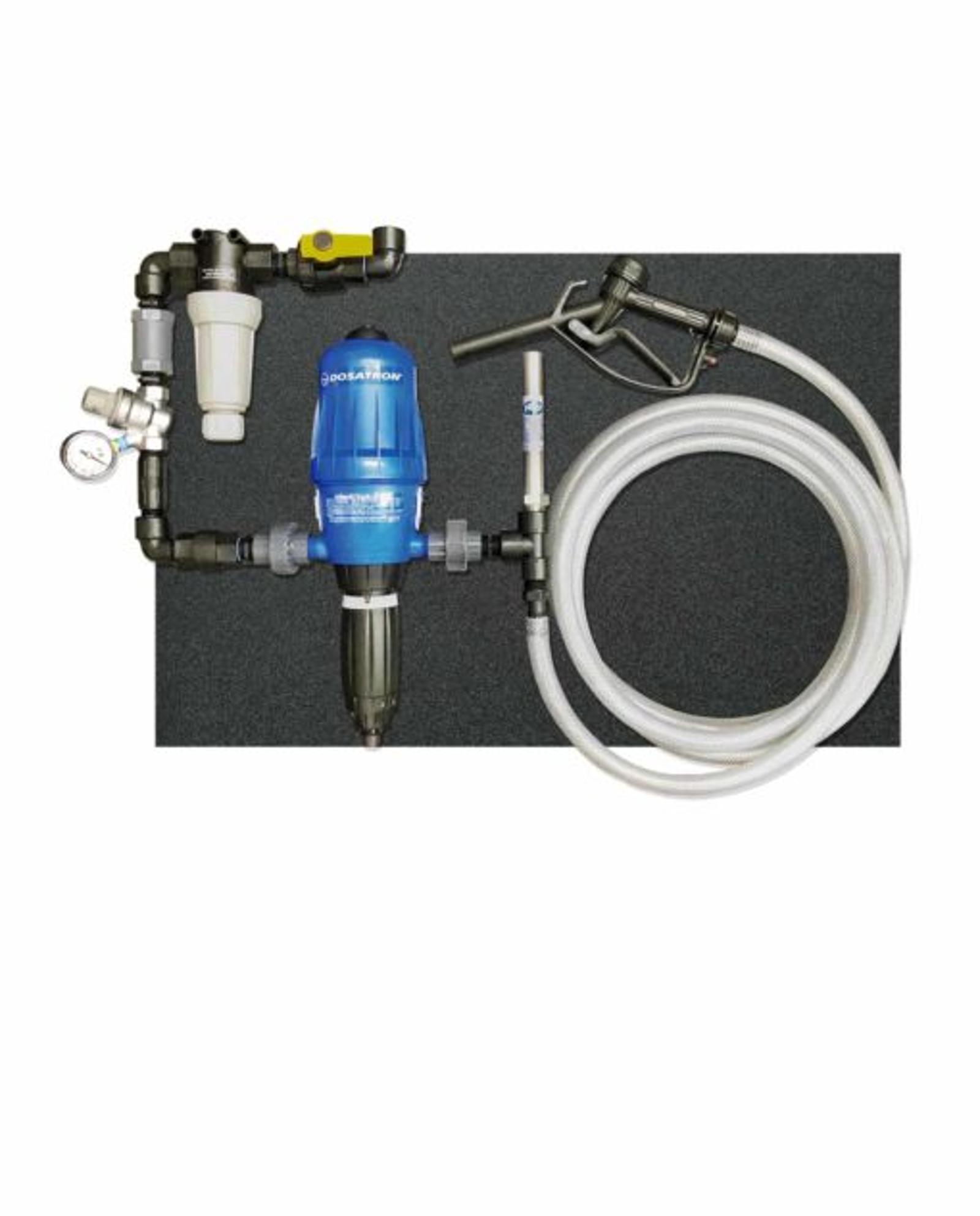
A Dosatron coolant mixer is a water-powered, positive-displacement dosing pump — not a venturi. Water flowing through the unit drives an internal piston motor; each stroke displaces a fixed, pre-set volume of concentrate into the water stream. Because the concentrate charge is tied to the volume of water passing through the pump rather than to line pressure, the delivered ratio holds constant across the unit's rated flow range.
Dosatron design principle | What it means on the shop floor |
Proportional mixing | The coolant-to-water ratio is set once and maintained automatically — the same ratio applies whether you're filling a 5-litre bucket or a 200-litre sump |
Positive-displacement technology | Mixing accuracy stays stable even when water pressure changes during the shift — no re-calibration needed when other machines draw water |
Non-venturi design | No suction-driven clogging risk; the piston motor stays precise and reliable even with viscous semi-synthetic and synthetic concentrates |
Simple maintenance | Dosatron coolant mixers are built for a single annual maintenance check — set the ratio, check concentration periodically with a refractometer or test kit, and adjust only if needed |
Once installed and set, a Dosatron mixer delivers consistent, repeatable results without the frequent fine-tuning a venturi system demands — the dial is set, the water does the rest.
Turnkey Systems Sized to How Your Shop Actually Fills Coolant
Every facility fills coolant differently, so Dosatron offers pre-plumbed systems built around two core use cases rather than a single generic injector:
Bucket or Sump Fill Systems
For shops topping off individual machines or preparing coolant at a single workstation, a panel-mounted mixing system pairs a Dosatron injector with the valves, filter, pressure regulator and test port needed for a plug-and-play install. Dosatron's own Coolant or Cleaner Blending System, for example, mounts a D14MZ10VAFII pump (1–10% concentration range) on a 24" × 24" panel with a test port and all required fittings — installed and commissioning-ready out of the box.
Central Coolant Distribution Systems
For facilities feeding multiple machines from one water line, a central Dosatron installation holds ratio regardless of how many sumps are drawing simultaneously — because the pump doses in proportion to total flow, not to the pressure seen by any one point of use. Multiple units can also be installed in parallel to scale a central system beyond a single injector's rated flow.
Mobile Coolant Fill
For shops that currently carry buckets of mixed coolant to the machine, the Dosatron Mobile Coolant Fill System (HS25) integrates a 14 GPM-rated injector with a 25-gallon polyethylene tank, a 10-foot delivery hose and a gasoline-style fill gun on a four-wheel, no-tilt cart with built-in refractometer storage — so mixed coolant is dispensed directly at the machine instead of hand-carried.
Match the Mixer to the Chemistry: The Four Metalworking Fluid Families
Dosing accuracy only pays off if the coolant itself is right for the job. The four families below cover most metalworking fluid selection decisions:
Water-Soluble Oils
A blend of oil and water forming an emulsion on mixing, balancing cooling and lubrication — the water carries heat away while the oil film protects the tool. Common for general machining, often formulated with rust inhibitors, sump-life extenders and foam control. Because they support microbial growth more readily than lower-oil formulations, concentration control (and the biocide load that comes with it) is not optional.
Semi-Synthetic Coolants
A lower-mineral-oil blend combining features of water-soluble and full-synthetic fluids — less oily, still lubricating, and cooling better due to higher water content. Cleaner in operation with reduced misting and residue, and generally lower bacterial growth than straight water-soluble oils, which typically means fewer sump-maintenance problems.
Synthetic Coolants
Oil-free formulations of water and chemical additives delivering strong cooling and rust protection — well suited to grinding and high-speed cutting where heat management matters more than heavy lubrication. Because they carry no oil, machines and parts stay cleaner, sump life extends, and airborne mist and odor issues are reduced. They are a poor fit, however, for operations demanding high lubrication such as threading or deep-hole drilling.
Straight (Neat) Oils
Undiluted mineral or petroleum oils carrying additives such as sulfur, chlorine or phosphorus to enhance lubrication and prevent metal-to-metal contact under high pressure. Essential for heavy-duty operations — threading, broaching, deep-hole drilling — where tool life and surface quality depend on lubrication more than cooling. Trade-offs include limited cooling capacity, higher mess/cleanup burden, and mist-related health and environmental considerations.
Choosing the Right Coolant for the Job
Coolant family | Where it fits best |
Water-soluble | High-speed milling and general-purpose machining |
Semi-synthetic | General-purpose machining balancing cooling and lubrication with cleaner operation |
Synthetic | Grinding and high-speed cutting where heat control is the priority |
Straight oil | Heavy-duty operations — threading, broaching, deep-hole drilling — where lubrication takes precedence over cooling |
Why the Ratio Itself Is the Real Cost Driver
Concentration control isn't a nice-to-have — it's what the fluid was formulated to deliver at a specific ratio, and drifting either direction has a real cost:
- Under-concentration reduces the lubricating film and corrosion-inhibitor load at the cutting zone, accelerating tool wear, degrading surface finish, and leaving machined surfaces and sump components exposed to rust. It also drops biocide and pH-buffer levels below the threshold that suppresses bacterial growth — and metalworking sumps are warm, nutrient-rich environments that support that growth quickly once it starts.
- Over-concentration wastes concentrate cost on every top-up, increases foam (which disrupts chip evacuation and can cause pump cavitation), adds to residue on finished parts, and raises dermatitis risk for operators handling more concentrated fluid than the formulation calls for.
A Dosatron mixer removes the variable that causes both failure modes: every litre of make-up or fresh-fill water carries the same, pre-set ratio of concentrate, whether the sump is filled quickly or slowly, first thing Monday morning or during a multi-machine wash-down.
What Shops Say After Switching
"As someone who’s spent years in metalworking, I’ve seen the hassle of hand-mixing coolant or using venturi systems. They often require constant adjustments, which can be frustrating and time-consuming. Since switching to Dosatron’s coolant mixers, it’s been a game changer. Proportional mixing means I always get the right coolant-to-water ratio, and I don’t have to worry about changes in water pressure affecting the results."
Reach out to us