
Industries
Animal Health
Car Wash
Data Centers & Mission-Critical Cooling
Food Safety & Sanitation
Irrigation
Hemp
Mining & Aggregates
Nutrient Delivery System
Water Treatment
Metal Processing
Printing
Products
D07
Hobby Cultivator
D128
D25
DM11 (Diaphragm)
D14
D6
D40
D20
D132
D400
Carts
Installation-Ready Systems
Venturi
Discontinued Products

NSF/ANSI 61 is the certification framework that determines whether a product is permitted to contact potable water in North America. It applies to every component of a drinking water system that wets in normal operation — pipes, fittings, tanks, valves, dosing pump bodies, seals, gaskets and injection assemblies — and it is referenced explicitly or by adoption in plumbing codes and drinking water rules across the United States and Canada.

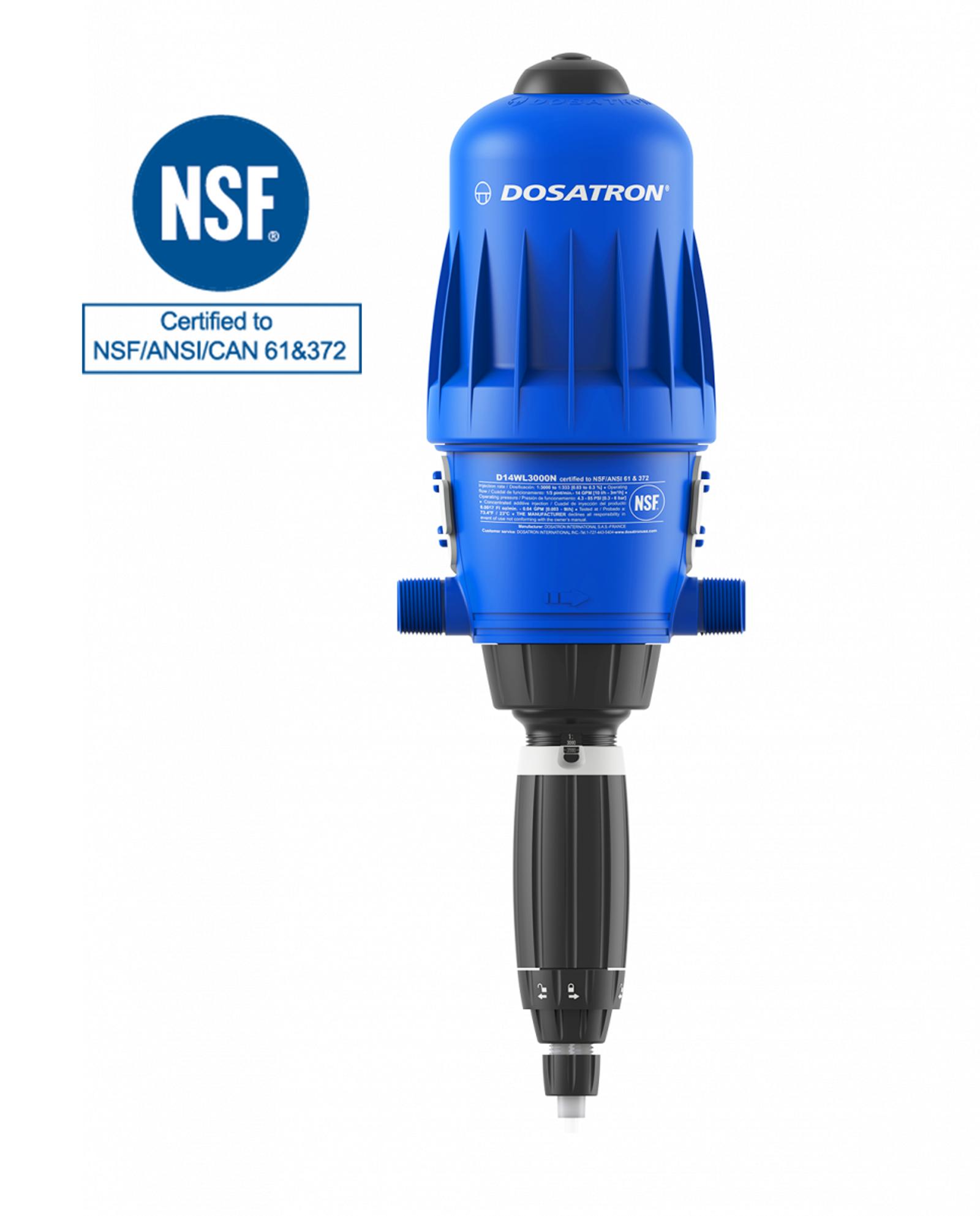
For specifiers of chlorination equipment, the NSF/ANSI 61 mark is not a marketing claim. It is the binary that determines whether a unit can be installed on a potable line at all. This page documents what the certification covers, how the testing is conducted, how NSF/ANSI 372 layers low-lead compliance on top, which Dosatron chlorinators carry both certifications, and how to verify performance once an NSF-certified unit is installed.

What NSF/ANSI 61 Actually Certifies

NSF/ANSI 61 is the Drinking Water System Components — Health Effects standard. It evaluates whether the materials in contact with drinking water leach any regulated substance at concentrations that could affect public health.

The standard does not evaluate mechanical performance, dosing accuracy, or operational reliability. It evaluates a single question: under standardized exposure conditions, do the wetted materials of the product release any harmful substance into the water above the regulated threshold?

The substances evaluated include:

  • Regulated metals — lead, arsenic, cadmium, chromium, mercury, antimony, barium
  • Volatile and semi-volatile organic compounds
  • Monomers and residual catalysts from polymer materials
  • Plasticizers and other formulation additives

A product earns NSF/ANSI 61 certification only when every wetted material — body, seals, gaskets, internal piston, injection assembly — passes every regulated threshold.
How NSF/ANSI 61 Testing Is Conducted

The certification process is operated by accredited certification bodies — NSF International, IAPMO R&T, WQA Gold Seal, UL Solutions, CSA Group — and follows a structured sequence:

  1. Formulation review. The manufacturer submits a complete bill of materials for every wetted component, including base resins, additives, colorants and process aids.
  2. Toxicological evaluation. Materials are reviewed against the regulated contaminant list and any compound of concern.
  3. Exposure testing. The product is exposed to standardized test water under controlled conditions of temperature, pH, residence time and surface-area-to-volume ratio.
  4. Effluent analysis. The exposed water is analyzed in an accredited laboratory for the regulated contaminants and any compound flagged in the toxicological review.
  5. Threshold comparison. Each measured concentration is compared against the regulated maximum allowable concentration. A single exceedance disqualifies the product.
  6. Manufacturing audit. The certifying body conducts an on-site audit of the manufacturing facility to verify that production matches the certified formulation.
  7. Certification listing. The product is added to the certifying body's public listing and is authorized to display the NSF/ANSI 61 mark.
  8. Periodic re-audit. Certification is maintained through scheduled re-audits and re-testing.

The result is a continuously verified guarantee that the certified product does not contaminate the water it contacts.

NSF/ANSI 372 — The Low-Lead Overlay

NSF/ANSI 372 is the companion standard for low-lead compliance, aligned with the US Reduction of Lead in Drinking Water Act (effective January 2014). It certifies that the weighted average lead content of all wetted surfaces is below 0.25%.

For products in contact with potable water in the United States since 2014, NSF/ANSI 372 compliance is mandatory. NSF/ANSI 61 and NSF/ANSI 372 are typically certified together; a product carrying both is fully qualified for potable water service throughout North America without further chemical due diligence by the specifier.

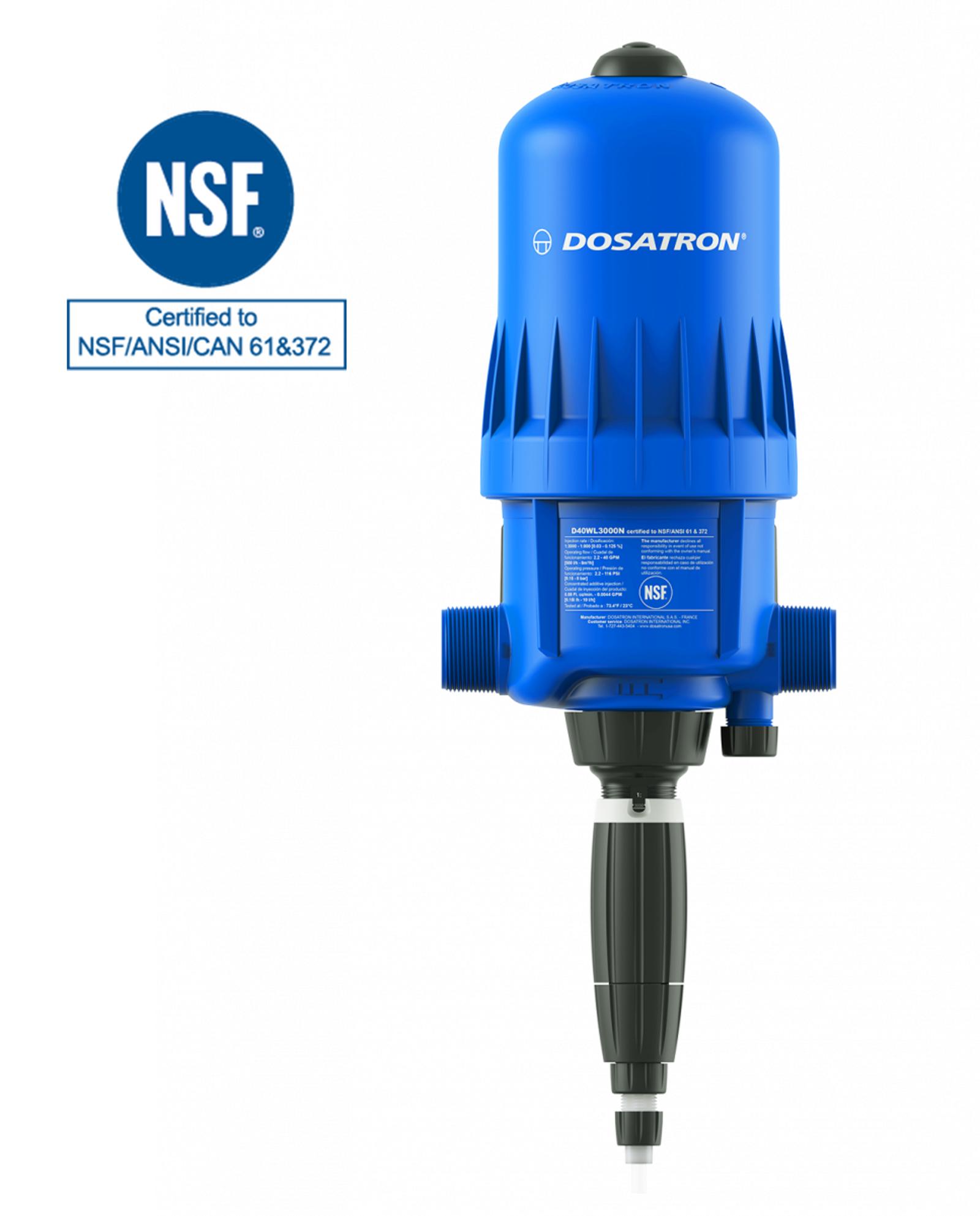
Certified chlorinators for safe water treatment

Why NSF/ANSI 61 Matters to the Specifier

The certification translates into four specific benefits at the specifier and operator level:

  • Regulatory compliance — Most US state plumbing codes and Canadian provincial drinking water standards reference NSF/ANSI 61 either explicitly or by adoption. Inspectors look for it; non-compliant components are grounds for non-acceptance.
  • Public health protection — The certification confirms that no harmful substance is released into the water during normal operation. The water that reaches the consumption point is chemically equivalent to the water that entered the unit.
  • Reduced liability exposure — Facilities serving potable water to occupants, visitors, employees or animals carry liability if the water is contaminated by treatment equipment. Specifying NSF/ANSI 61 certified components reduces that exposure materially.
  • Simplified due diligence — Engineers and procurement teams do not need to conduct independent chemical testing on certified components. The certification stands in for that due diligence.

Why Dosatron's Design Lends Itself to NSF Certification

A Dosatron chlorinator's design eliminates several categories of contamination risk that complicate NSF certification on competing technologies:

  • Water-powered operation. There are no electrical components in contact with the water flow path, eliminating contamination risk from windings, electrical insulation, motor lubricants and electronic components.
  • Hydraulic-mechanical actuation. There are no oils, greases or lubricants in contact with the water flow path. The unit is lubricated by the water itself.
  • Materials selected for chlorine compatibility. The body, seals and injection components are engineered to maintain chemical integrity under sustained sodium and calcium hypochlorite exposure.
  • Single annual seal-kit service. Maintenance does not introduce proprietary chemicals, solvents or sealants that would alter the certified material composition.

These design properties reduce the certification surface to a tractable set of polymer components and elastomer seals, all of which pass the NSF/ANSI 61 & 372 test program.

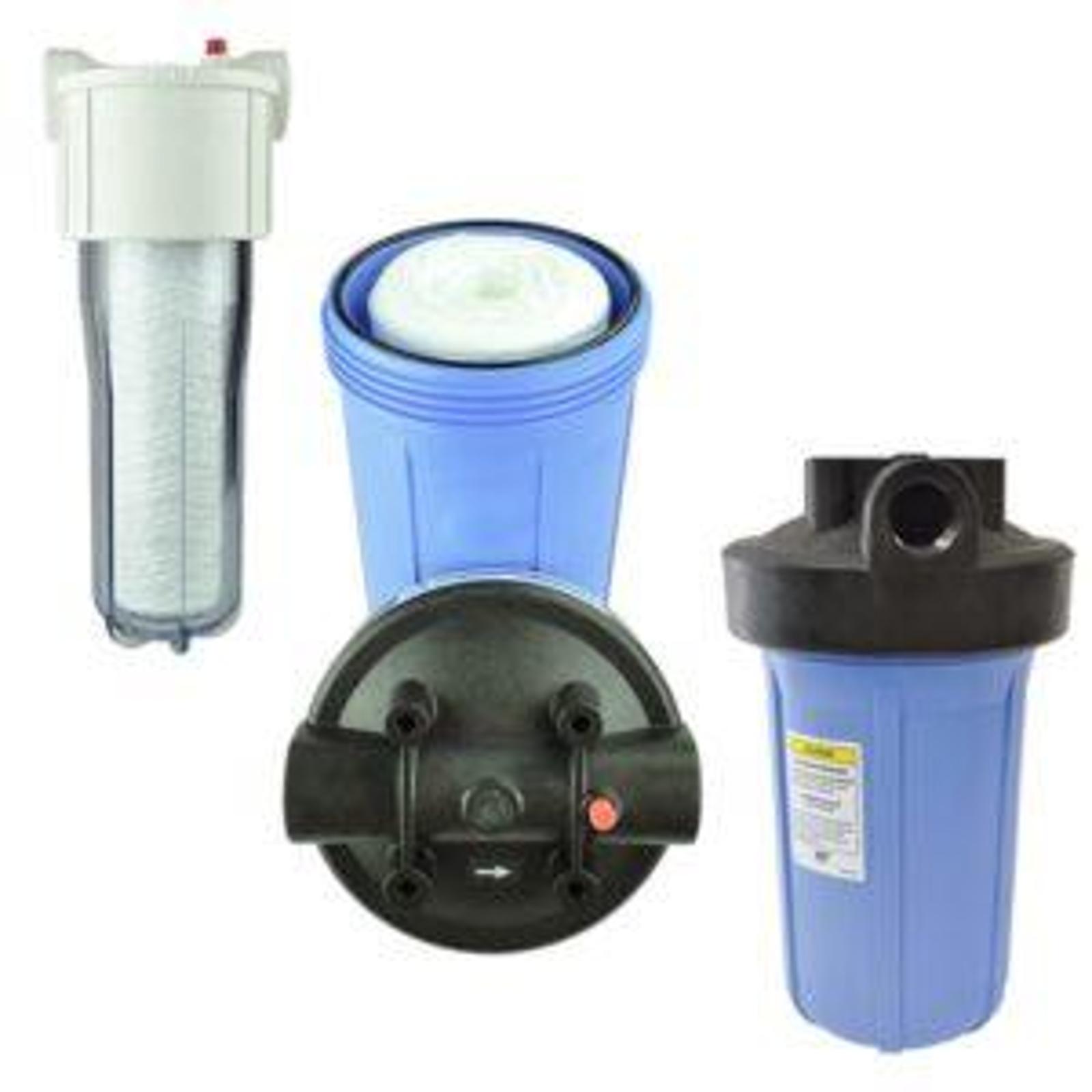
Complete Your System with NSF 61 Certified Filters

To keep your Dosatron chlorinator working at its best, use it with NSF 61 certified filters. These filters remove dirt and small particles from the water. This helps protect the chlorinator from damage and keeps your water clean and safe.

Hemp Fertilizer Pump View 8