
Industries
Animal Health
Car Wash
Data Centers & Mission-Critical Cooling
Food Safety & Sanitation
Irrigation
Hemp
Mining & Aggregates
Nutrient Delivery System
Water Treatment
Metal Processing
Printing
Products
D07
Hobby Cultivator
D128
D25
DM11 (Diaphragm)
D14
D6
D40
D20
D132
D400
Carts
Installation-Ready Systems
Venturi
Discontinued Products

Most operators obsess over the first and inherit the second from whatever was bolted to the wall when they bought the site. Wash performance is the product of both variables — either one at the wrong value degrades the result. This guide treats both quantitatively: the product families that do the cleaning, the water chemistry that helps or fights them, and the four delivery methods that decide whether you capture the value.

The Chemistry, by Function and pH

Each product family attacks a specific soil by a specific mechanism, in a specific pH window, at a specific dose. Sizing your dosing to these is the whole game:

Product

Mechanism

pH

Typical dose

High-pH presoak

Saponification / emulsification of organic road film, oils, insects

11–13

0.4–1.0% (1:100–1:256)

Low-pH presoak

Acid attack on inorganic film; brightens; cuts hard-water & salt

1–3

0.25–0.8% (1:128–1:400)

Detergent (surfactant)

Surfactants lift + suspend soil above the CMC

7–10

0.5–1.5% (1:64–1:200)

Drying agent

Cationic polymer lowers surface tension → sheeting

3–6

0.1–0.25% (1:400–1:1000)

Wheel / tire acid

Dissolves brake dust, iron oxide

≤ 2

1.5–10% (1:10–1:64)

The Two-Step Process — Chemistry in Sequence

The industry-standard deepest clean applies a low-pH presoak first, then a high-pH presoak, each with ~10–12 seconds of dwell. The acid pre-conditions inorganic film and hard-water deposits; the subsequent alkaline step — aided by the partial acid–base reaction at the surface — saponifies and lifts the loosened organic soil, so the friction or high-pressure stage finishes with minimal effort. Under-dose or short the dwell on either step and the soap downstream carries the full load, producing dirty cars and re-washes.

Water Chemistry Is a Hidden Variable

Surfactant efficiency falls in hard water: Ca²⁺ and Mg²⁺ ions consume anionic surfactant and precipitate as film. Above roughly 7 gpg (≈120 mg/L as CaCO₃), builders/sequestrants (phosphonates, citrates) or softening/RO are required to hold cleaning performance and prevent spotting. Match your dose to source-water hardness, not to a generic label rate.

Dosificadores de dilución química para lavado de autos

The Delivery Method — Four Ways to Blend, Ranked

How you mix is not a detail; it's the difference between a consistent 0.5% dose and a capful thrown on the ground. Worst to best for a production wash:

Method

Draw mechanism

Ratio vs. pressure

Dominant failure mode

1. Hand-mixing

Manual measuring

Operator-dependent

Shift-to-shift variance, waste

2. Venturi 

Bernoulli ΔP (1797 principle)

Varies with P and flow

Orifice clog, tip-size compromise

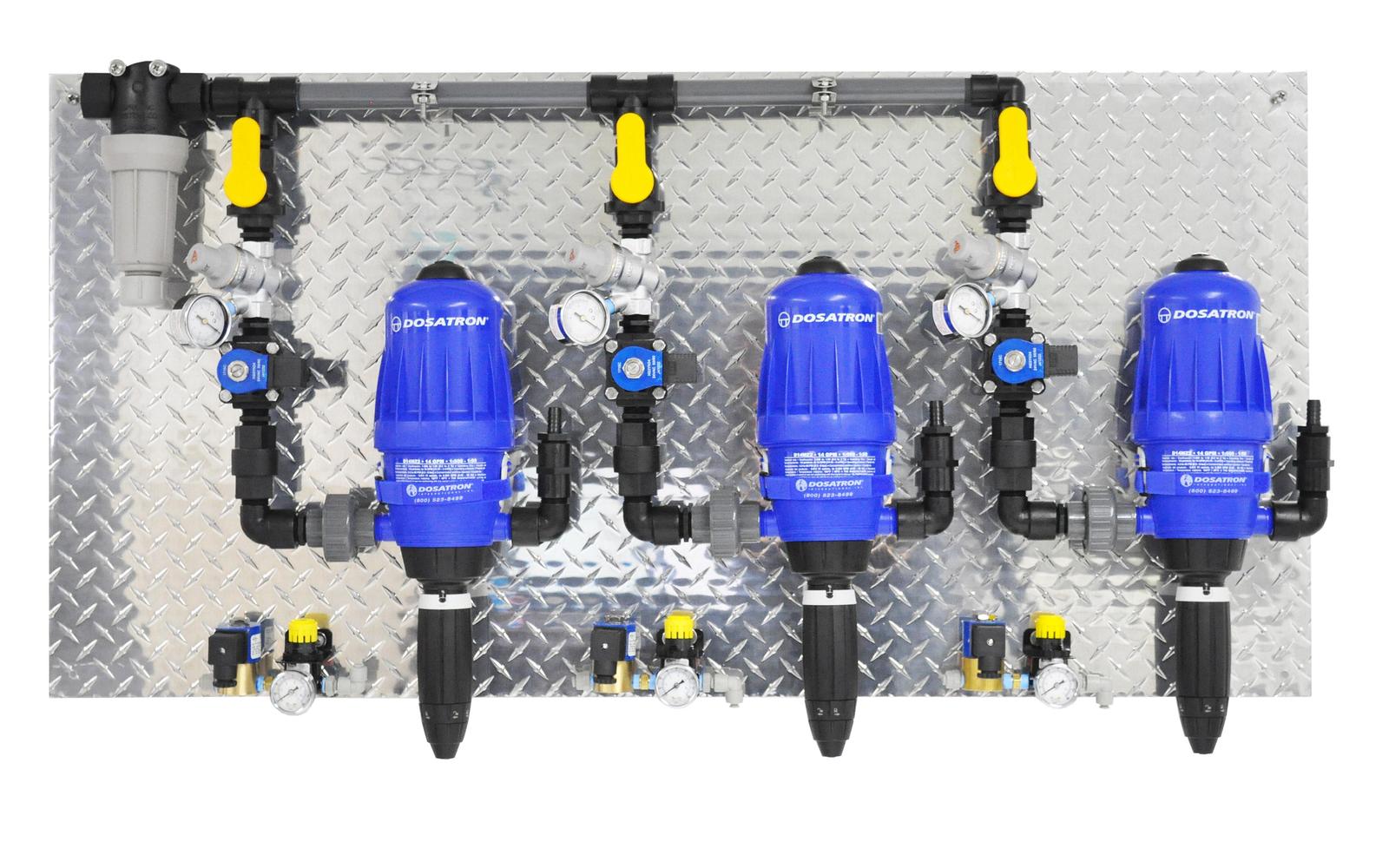
3. Proportional injector (Dosatron)

Positive displacement

Constant

Seal wear — predictable, annual PM

4. Electric diaphragm metering pump

Controller + stroke

Constant

Needs power/controller; more failure points

Why Water-Powered Proportioning Wins in Most Bays
  • Consistency — volumetric dosing holds ratio across the whole 4.3–85 psi window. 
  • Uptime — runs off city pressure if the booster fails; no freeze-prone air diaphragm pumps.
  • Durability — metal-free piston, no venturi orifice, corrosion-resistant across pH.
  • Simplicity — on-demand mixing removes stock tanks; external stem adjusts dilution live.
How a Dosatron Works

Water entering the dosing pump drives a hydraulic piston up and down; the piston draws concentrate from the drum syringe-style and blends it directly into the through-flow in the mixing chamber, at a fixed percentage of water volume. Flow doubles, dose doubles; flow halves, dose halves.