
Truck & Fleet Wash: High-Flow, High-Temperature Chemical Dosing
Heavy-duty and fleet washes raise every process variable at once: more surface area, more baked-on soil (road film, diesel exhaust soot, insects, road salt), aggressive alkaline chemistry, elevated water temperature, multi-nozzle manifolds, and — in fleet and tunnel formats — operation measured in shifts, not cars. Positive-displacement, water-powered injectors are built for exactly this duty: high flow, aggressive chemistry, and uptime that holds under continuous load.
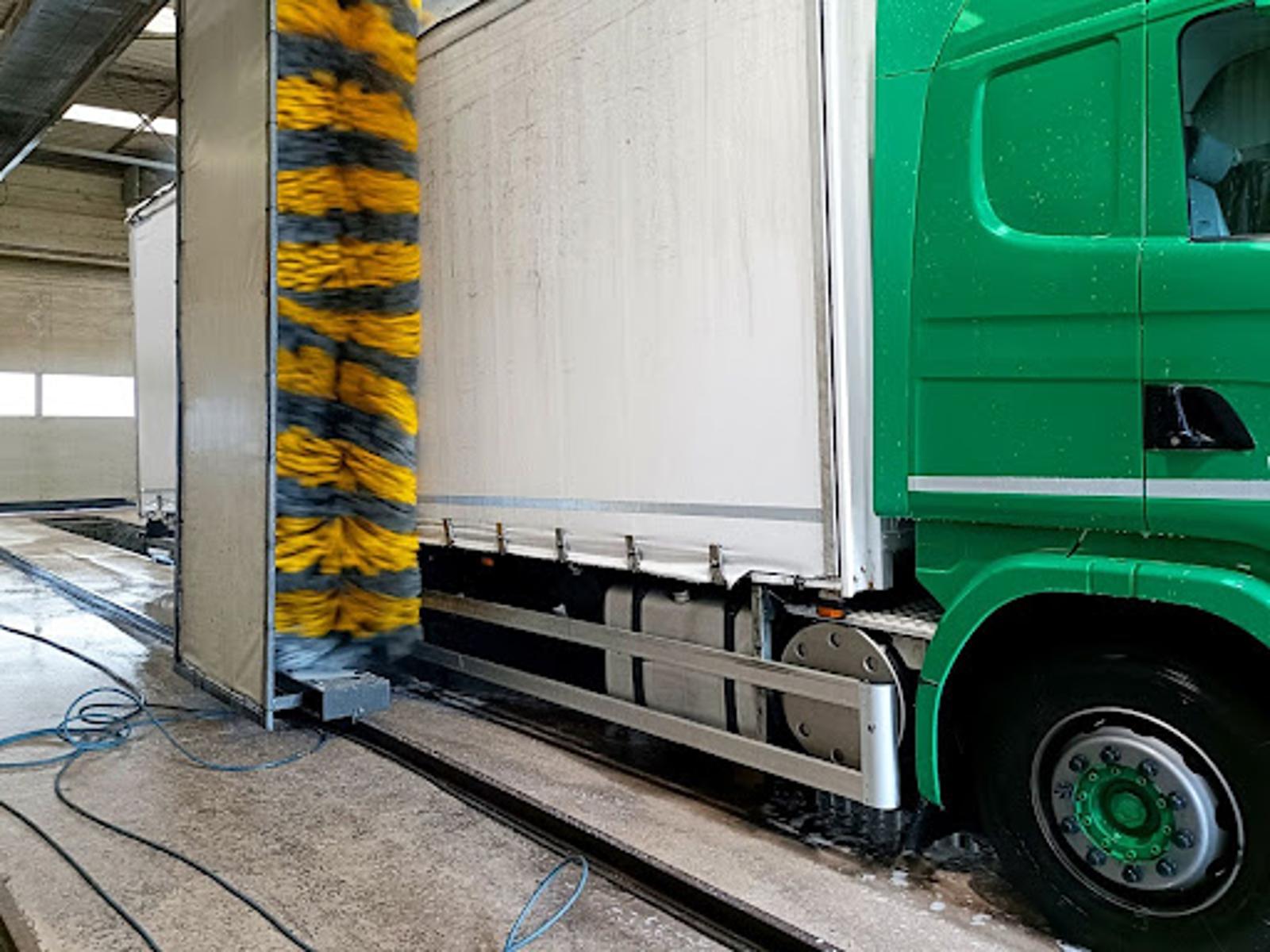
The Real Problems on a Truck-Wash Floor & Their Root Cause
Problem | What it looks like | Root cause |
Inconsistent cleaning | Some rigs come out under-cleaned, others drowned in chemical | No fixed ratio |
Chemical waste | Overdosing at truck-wash volumes turns small % errors into large monthly cost and disposal load | Uncontrolled dose |
Labor drain | Refilling and hand-measuring concentrate ties up crew during peak throughput | Manual mixing |
Safety exposure | Crews handling concentrated presoak and caustic detergent by hand | Direct handling |
At truck-wash volumes, a small percentage dosing error is no longer a rounding detail — it's a recurring monthly cost and an effluent-disposal burden
The Governing Constraints
Truck wash imposes four hard engineering constraints, and each has a defined answer:
- Flow — multi-nozzle arches exceed a single small injector's band. Size up the injector (D40, to 40 GPM); don't raise the pressure to compensate.
- Temperature — hot water improves saponification of oily soil but degrades incompatible elastomers. Use the hot-water series with correct seals, rated to 70 °C (158 °F).
- Chemistry — high-pH presoaks require Aflas (FEPM) seals. Running VF seals on caustic causes rapid wear and downward ratio drift.
- Duty — continuous operation makes venturi orifice clogging and air-diaphragm freeze the dominant downtime causes. A non-electric, positive-displacement unit removes both.
How Volumetric Proportioning Handles It
A Dosatron is a positive-displacement, water-driven dosing pump: incoming flow powers a hydraulic piston that draws concentrate from your drum and injects it at a fixed percentage of the water volume. Because dosing is proportional to flow — not pressure — the ratio holds across every nozzle on the arch, even as demand swings.
- Precise dose, every rig — set the ratio once; the unit meters the exact percentage automatically across the whole manifold.
- Reduced waste — volumetric proportioning eliminates the overdose habit; you use only what the wash needs.
- Hands-off efficiency — automated mixing frees crew for throughput and service, not measuring.
- Safer operation — far less direct handling of concentrated presoak and detergent.

Injector Selection Matrix
Match the platform to your arch's flow, temperature and chemistry:
Requirement | Selection | Rationale |
Standard truck arch | D14MZ up to 14 GPM | Matches single-arch flow |
High-flow / multi-nozzle manifold | D40MZ up to 40 GPM | Feeds the full manifold without starving |
Hot-water bay | D14TMZ to 158 °F | Elastomers rated for temperature |
High-pH / caustic presoak | D14MZ10 + Aflas seals, 1:100–1:10 | pH and high-dose compatibility |
Reach out to us