
Cannabis Iron Deficiency: Symptoms, Causes & How to Fix It
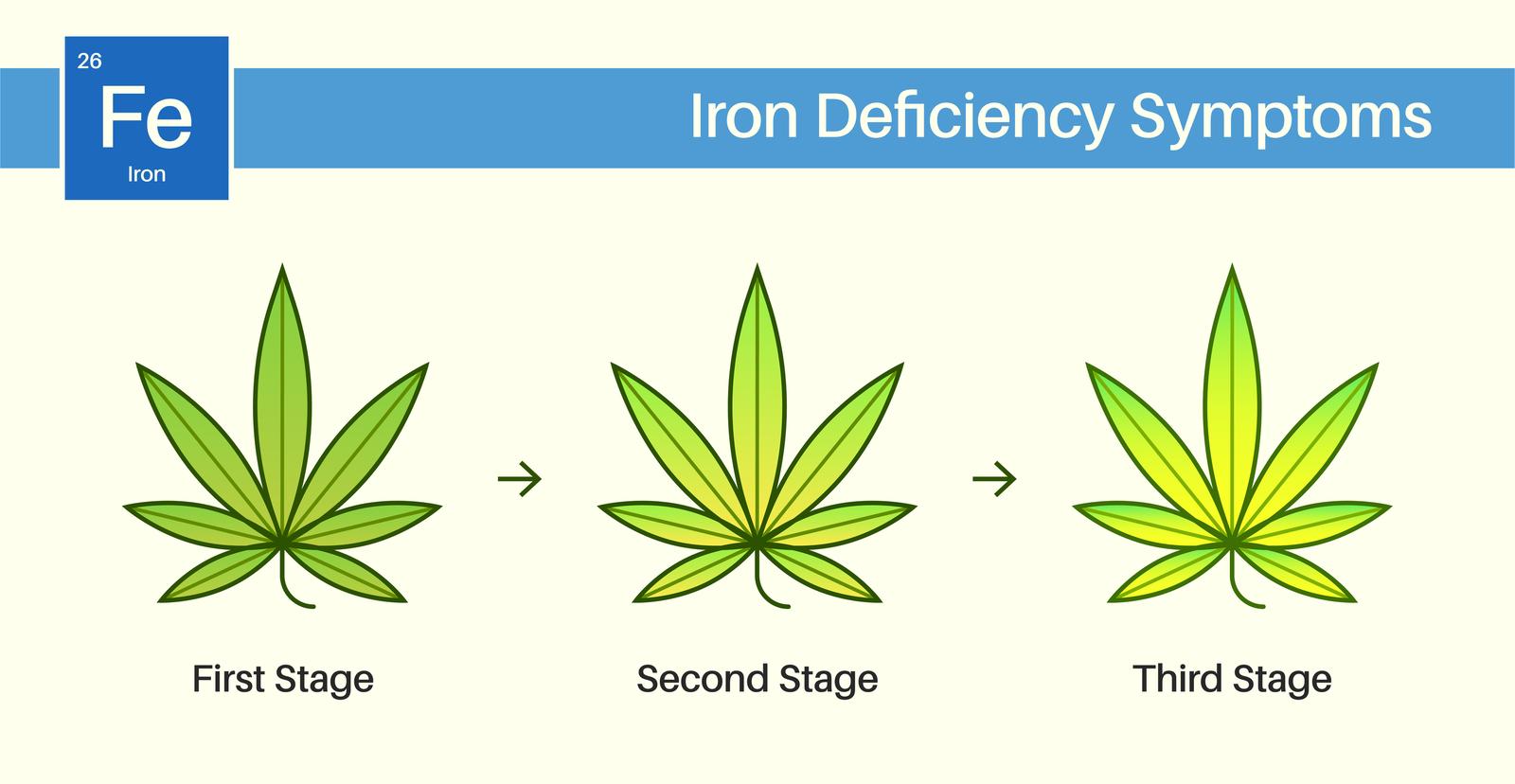
How to recognize iron deficiency
Iron is immobile. The plant can't move it from older leaves, so symptoms appear on the newest growth at the top of the plant.
- New leaves turn pale yellow between the veins, while the veins stay green (interveinal chlorosis).
- In severe cases, new leaves become almost entirely yellow or whitish.
- Older leaves usually stay green and healthy.
- Slowed growth at the tops of the plant.
Tip: magnesium deficiency produces a similar yellowing between green veins, but on older leaves. Where the symptom appears is the fastest way to tell them apart.
Common causes
Iron is rarely missing from the feed; it simply becomes unavailable when pH rises. Iron availability falls quickly once pH climbs past the mid-6s. Aim for the lower end of the range: roughly 6.0–6.5 in soil and 5.5–6.0 in hydroponics and coco.
How to fix iron deficiency in cannabis
- Check and correct pH at input and runoff (or in the reservoir). In most cases this alone solves it.
- If needed, flush gently with pH-adjusted water to reset the root zone.
- Use a chelated iron source. Fe-EDTA works best at lower pH, Fe-DTPA holds up to around neutral pH, and Fe-EDDHA stays available at higher pH.
- Improve drainage and avoid overwatering so roots stay oxygenated.
- For hard water, add acid injection to bring alkalinity down before it reaches the plants.
- Watch new growth: leaves that emerge after the fix should come in green within several days.
Deficiency at a glance
| Iron deficiency |
Mobility | Immobile — new growth first |
Key signs | Pale yellow new leaves with green veins; whitish tops in severe cases |
Main cause | pH too high |
Ideal pH | Soil 6.0–6.5, hydro/coco 5.5–6.0 |
Common mix-up | Magnesium deficiency (older leaves), manganese deficiency |
How Dosatron helps
Iron deficiency is usually a pH and water-quality problem, which makes it a dosing problem. Dosatron proportional pumps can inject acid to control alkalinity and pH, plus micronutrient or chelated iron solutions, at a constant ratio into the irrigation line. Using separate injectors for iron and phosphates helps avoid precipitation in concentrated stock tanks. They run on water pressure alone, no electricity needed.
The newest leaves at the top of the plant, because iron is immobile.
Reach out to us