
Industries
Animal Health
Car Wash
Data Centers & Mission-Critical Cooling
Food Safety & Sanitation
Irrigation
Hemp
Mining & Aggregates
Nutrient Delivery System
Water Treatment
Metal Processing
Printing
Products
D07
Hobby Cultivator
D128
D25
DM11 (Diaphragm)
D14
D6
D40
D20
D132
D400
Carts
Installation-Ready Systems
Venturi
Discontinued Products

Chlorination comes down to one relationship: the mass of chlorine delivered must stay proportional to the volume of water treated, at every flow rate the system will ever see. Electronic pumps approximate that with a sensor loop; Dosatron chlorinators achieve it mechanically, with the injection ratio locked directly to the water flow that drives the unit. 

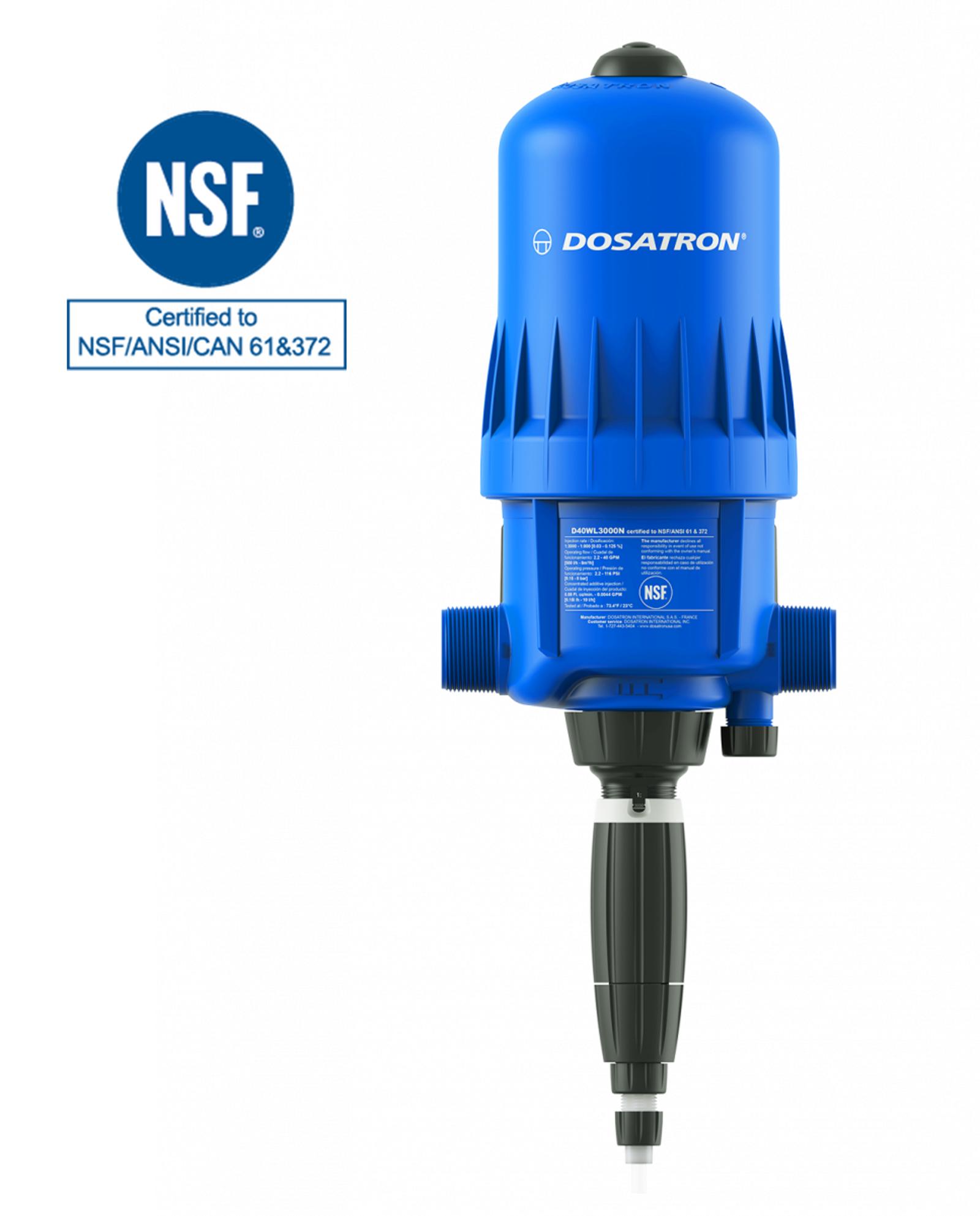
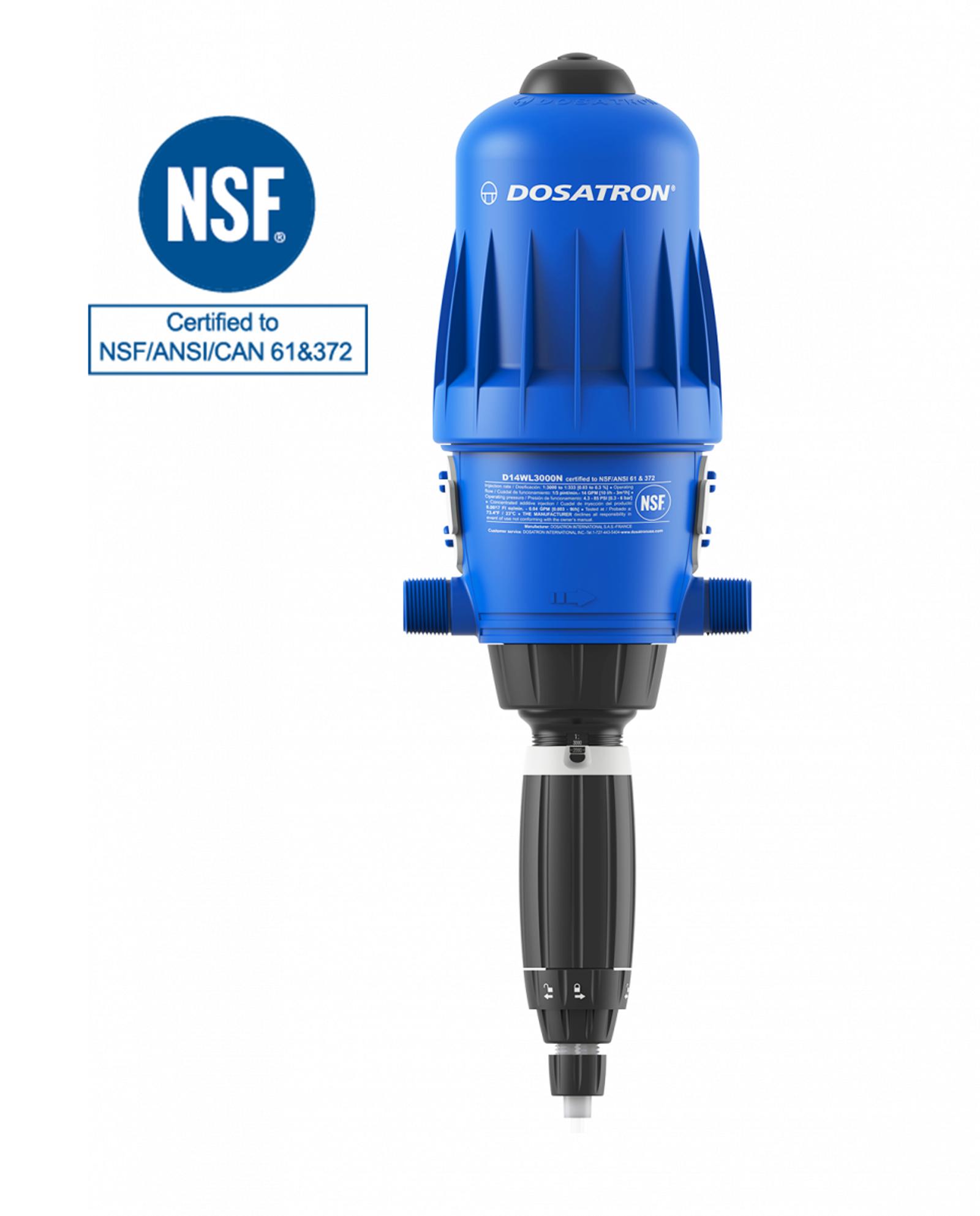
A Dosatron chlorinator installs in-line on the main water service. Water flow itself strokes an internal hydraulic piston, and each stroke draws and injects a fixed volume of chlorine solution — sodium hypochlorite or calcium hypochlorite — into the line at a ratio set between 1:3000 and 1:150. No electricity, no controller, no calibration drift. It is the only line of water-powered chlorinators certified by NSF to NSF/ANSI 61 & 372. 

Why Dosatron Chlorinators?

Water-powered

Proportional dosing

NSF/ANSI 61 & 372 certified

No electricity

Self-priming to 4m

Low, predictable maintenance

Governing Principle: Proportional Dosing

Dose volume injected  =  Injection ratio (R)  ×  Water volume passed 

Because R is fixed mechanically by the piston-and-chamber geometry rather than by a sensor, the free-chlorine concentration delivered to the line stays constant at any instantaneous flow inside the rated range — a single tap opening at 0.05 GPM or a full-demand event at the top of the band. Flow doubles, dose doubles. Flow halves, dose halves. There is no setpoint to drift and no power dependency that can fail silently. 

Disinfection efficacy is governed by a second, downstream relationship — the CT value used across US and Canadian drinking-water regulation: 

CT  =  C (free chlorine residual, mg/L)  ×  T (contact time, minutes) 

For free chlorine at pH 7.0 and 20°C, roughly 104 mg·min/L achieves 3-log (99.9%) Giardia inactivation; ~6 mg·min/L achieves 4-log (99.99%) virus inactivation. A contact or retention tank sized for peak flow is what converts a correctly dosed line into a compliant one — dosing accuracy and contact-time sizing are two separate, both necessary, conditions.
Choose Your Chlorinator

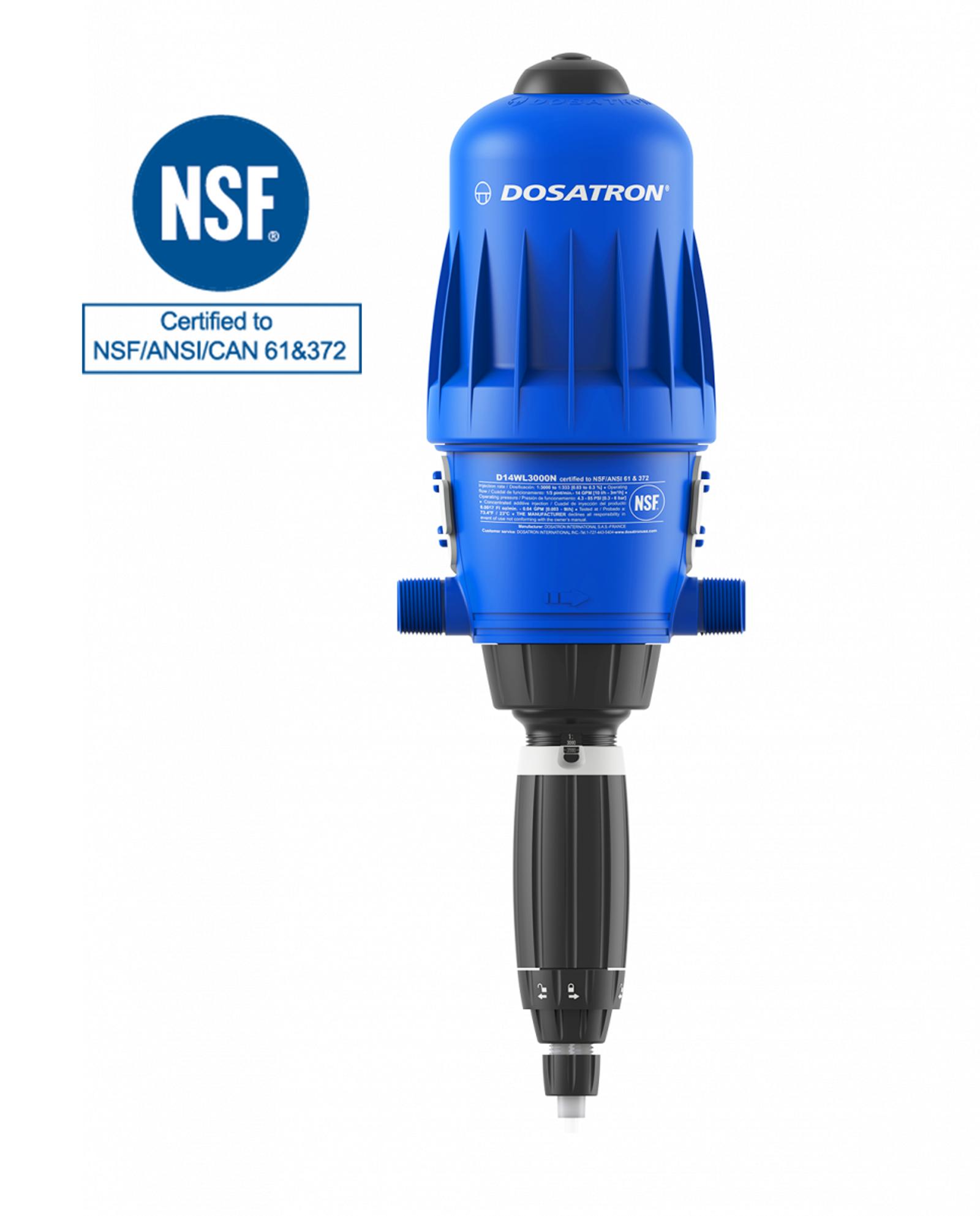
Both models share the identical dosing mechanism and injection-ratio range; the only design variable is throughput capacity.  Both operate across 4.3–85 psi (0.3–5.9 bar), self-prime to 4 m of lift, and carry NSF/ANSI/CAN 61 & 372 certification. Sizing error runs in one direction only: a unit rated below your peak instantaneous flow will under-dose during demand spikes, because injection is flow-linked, not time-linked. Both models accept sodium hypochlorite (NaOCl — 10–12.5% available chlorine at commercial strength, 5–6% for household bleach) and calcium hypochlorite solution (Ca(OCl)₂ — 65–70% available chlorine before dilution). NaOCl degrades measurably with heat and UV over weeks, which favors continuous-dosing sites with regular delivery; Ca(OCl)₂ stores dry for years, which favors remote or infrequently serviced sites.

Proven in the Field

At Pictured Rocks National Lakeshore (Michigan), the US National Park Service installed the Dosatron D14WL on off-grid potable water pumping stations and achieved consistent chlorine residuals where none had previously been maintained — verified by inspectors, with expansion to three additional stations. 

Need a Different Scale of Chlorination?

Dosatron chlorinators cover water-powered, NSF 61 certified point-of-use dosing up to 40 GPM — residential, well, off-grid, emergency, agriculture and F&B. Above that flow, or where you need ORP/SCADA feedback and controller-led metering, a Dosatron is mechanically the wrong tool.