
In many sectors such as automotive, chemistry, metallurgy, printing, pharmaceuticals or water treatment and wastewater treatment, accuracy and repeatability of processes are fundamental. These domains involve numerous dosing applications. Therefore, industrial dosing pumps play a crucial role.

Reach out to us
A wide range of chemical dosing pumps for your industrial applications
6 bar chemical metering pumps
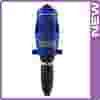
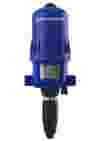
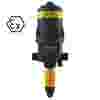
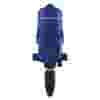
What are Dosatron specificities?
Dosatron dosing pumps differ from standard dosing pumps in two major aspects (check our specific page How does a dosing pump work?):
- They are non-electric: this means they are powered by the fluid being treated, usually water (for more information, refer to the page explaining the operation).
- They are proportional: this means that the desired injection rate is maintained regardless of variations in flow rate or pressure of the fluid in the hydraulic network where they are installed.
What are Dosatron advantages?
As a direct consequence of their specificities, they possess three major advantages:
- Being non-electric, their installation is simple, and they are insensitive to external constraints (ambient humidity, dust, various splashes, electromagnetic sensitivity, voltage drops, etc.).
- Because they are proportional by design, there is no need to add a water meter to the installation to control the injection rate based on the flow rate of the fluid being treated.
- They are self-priming, insensitive to dry running, and offer a highly optimized cost alternative for large dosages.
- They are chemically resistant to most types of chemical available on the market They can dose additives with high viscosity
- They operate at high pressures up to 8 bar
Role and Operation of an Industrial Dosing Pump
The function of an industrial dosing pump is to transfer or inject a defined volume of additive or liquid within a specified time frame. In most cases, the amount of liquid to be injected is related to the flow rate of a fluid in which it must be incorporated. Usually, the specifications are expressed in terms of injection flow rate and injection pressure.
The industrial dosing pump operates on the principle of a positive displacement pump. The transfer of chemicals is achieved through an injection head that, through a reciprocating motion, draws in and delivers a defined volume. In general, injection heads incorporate technologies such as "piston" or "membrane". The volume transferred is then related to the pump head type and stroke length. These technologies enable accurate injection of a specific quantity of liquid through each operating cycle, ensuring a constant flow rate and excellent repeatability.
As the chemical transfer is controlled based on the flow rate of a fluid to be treated, it results in accurate dosing of the additive into the fluid (e.g., dosing of soluble oil to lubricate and cool down the tool/workpiece interface during machining).
Different Types of Industrial Dosing Pumps
Since their introduction on the market, industrial dosing pumps have undergone numerous improvements and innovations to enhance their performance and provide value to their users. However, we can distinguish the following main families:
- Piston metering pump: the volume of additive transferred is defined by the movement of a piston in a cylinder.
- Diaphragm metering pump: the volume of additive transferred is defined by the deformation of a membrane, actuated by a translation along an axis.
- Peristaltic metering pump: the volume of additive transferred is defined by the compression of a flexible tube via one or more pressure rollers.
These pumps can also differ in their drive systems:
- Electric dosing pump: the dosing head is powered by an electric motor.
- Electromagnetic dosing pump: the dosing head is powered by an electromagnetic motor.