


Reach out to us
Drinking Water Treatment a Global Issue
An estimated 2.6 billion people lack adequate access to safe drinking water.
The production of drinking water for small communities that do not wish to use chlorine gas, for rural areas or for water supply in emergency situations requires reliable equipment adapted to sometimes extreme conditions.
These facilities must meet current health standards and ensure stability of service to the population.
A Well-mastered Dosing System Technology
Installed directly on the water supply line, the Dosatron Chlorine Dosing Pump works with the water in your network as the only source of energy.
- The pressure and flow of water drives the engine piston, which is itself connected to a metering piston.
- Chlorine or other disinfection chemicals are in proportion dosed and without interruption injected with water in a wide range of dosage
The dose of concentrated product is directly proportional to the volume of water flowing through the chemical dosing pump, regardless of variations in the flow rate and pressure of the water supply to the network.
Self-priming up to 4 meters, Dosatron Injection Pumps guarantee the coherence of the dilution. They allow direct reading and easy adjustment of the dosage value.
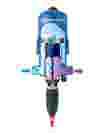
This historical concept developed in 1974 is now available for the first time with the Chlorine Dosing Pumps in the Water Line. Read more about the Dosing Pump Technology
The NSF or ACS mark on our Certified Chlorine Dosing Pumps is your assurance that the product has been tested by the most respected independent certification organizations in existence today.
Solar Impulse Label for Water Treatment Dosing Pumps
Water Line Water Treatment Dosing Pumps are Solar Impulse labeled.
The Solar Impulse Foundation helps corporate decision-makers and governments achieve their environmental goals and adopt more ambitious energy policies. The Solar Impulse Efficient Solution Label is one of the first labels for positive impact companies that combine environmental protection and financial viability. It aims to reward solutions that are both environmentally and financially sustainable.

Chlorine Dosing Pumps for Drinking Water Treatment Applications
- Chlorination upstream of the point of consumption or re-chlorination for rural communities
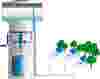
- Chlorination upstream of the point of consumption or re-chlorination for emergencies.

In these two cases, our metering pump allows the water disinfection (bactericidal, virucidal, fungicidal) with residual protection against potential low levels of post-treatment contamination.
Chlorine Dosing Pumps - Usage Reports
applicationreport-graviwater-en.pdf
Drinking water supply (DRC)
applicationreport-sade-en.pdf
Drinking Water Supply (Senegal)
applicationreport-brivadois-en.pdf
法国 - 水卫生

Case Study - Rural Drinking Water
Discover how Dosatron is addressing the global need for safe drinking water. Our case study highlights the significant strides made in Ivory Coast, where traditional manual pumps are now replaced by our efficient water solutions.
Advantages of a Dosatron Chlorine Dosing Pump
- Compatible with low gravitational pressure (reservoirs, hills, mountain springs).
- The precision is not dependent on the water pressure or the flow rate of the mains supply.
- Injection rate is easy to regulate.
- Easily repeatable injection rate.
- Easy maintenance at the installation site.
- Portability (Emergency Skids).
- Low operating and maintenance costs.
Why Using a Certified Chlorine Dosing Pump is Important ?
To make safe drinking water, the Dosatron ACS or NSF certified metering pumps, installed in line with the water pipe, inject a dose of chlorine (NaClo, CaClo) which allows the destruction of organic matter such as viruses and microbes contained in the water, in proportion to the flow rate.
Since a large part of the chlorine is needed to neutralize these organic materials, the dose of chlorine delivered by the metering pump will allow a part, called free residual chlorine, to remain available to treat possible future infection of the water in the network or in the homes.
This free chlorine allows for the persistence of the sanitizing capacity.
According to the WHO, in drinking water, the free chlorine concentration of the treated water should be 0.2 to 0.5 mg/l.
D20WL2 Chlorine Dosing Pump - Installation in partial bypass mode

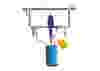
D3WL Chlorine Dosing Pump - Installation in full bypass mode
In this illustration, 100% of the water flow passes through the D3WL dosing pump.
Recommendations for a proper use of your Chlorine dosing Pump
- Chlorine degrades much more quickly in light. The solution tank should be made of dark plastic material, provided with a non-airtight lid. The installation should be positioned in a control room, in darkness, ventilated and protected from vandalism.
- Please respect local legislation relating to the purification of water.
- Ensure the minimum contact times necessary for ensuring a bactericidal and virucidal effect.
How to Make the Right Chlorine Dosage?
The new smartphone application from Dosatron will allow you to perform all your chlorination calculations and share them with anyone you want.
Recommended Certified Chlorine Dosing Pumps
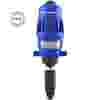
D3WL ACS
Enhance water treatment with Dosatron's D3WL ACS chlorine dosing pump for safe, precise dosing.
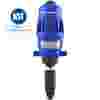
D3WL NSF
Optimize water treatment with Dosatron's D3WL NSF certified chlorine dosing pump.

D8WL ACS
Achieve efficient water treatment with Dosatron's D8WL ACS chlorine dosing pump.
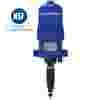
D8WL NSF
La gamme de doseurs D8WL-NSF a obtenu l'agrément français obligatoire pour tout équipement en contact avec l'eau destinée à la consommation humaine
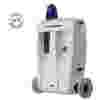
D30WL ACS
Ensure safe water treatment with Dosatron's D30WL ACS chlorine dosing pump for precision dosing.
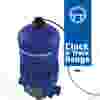
ILS Clack n' Track pulse emitter
The Reed switch Clack n' Track technology of our dosing pumps guarantees water treatment management in isolated areas.